
La respuesta rápida: cuál conviene según tu viaje
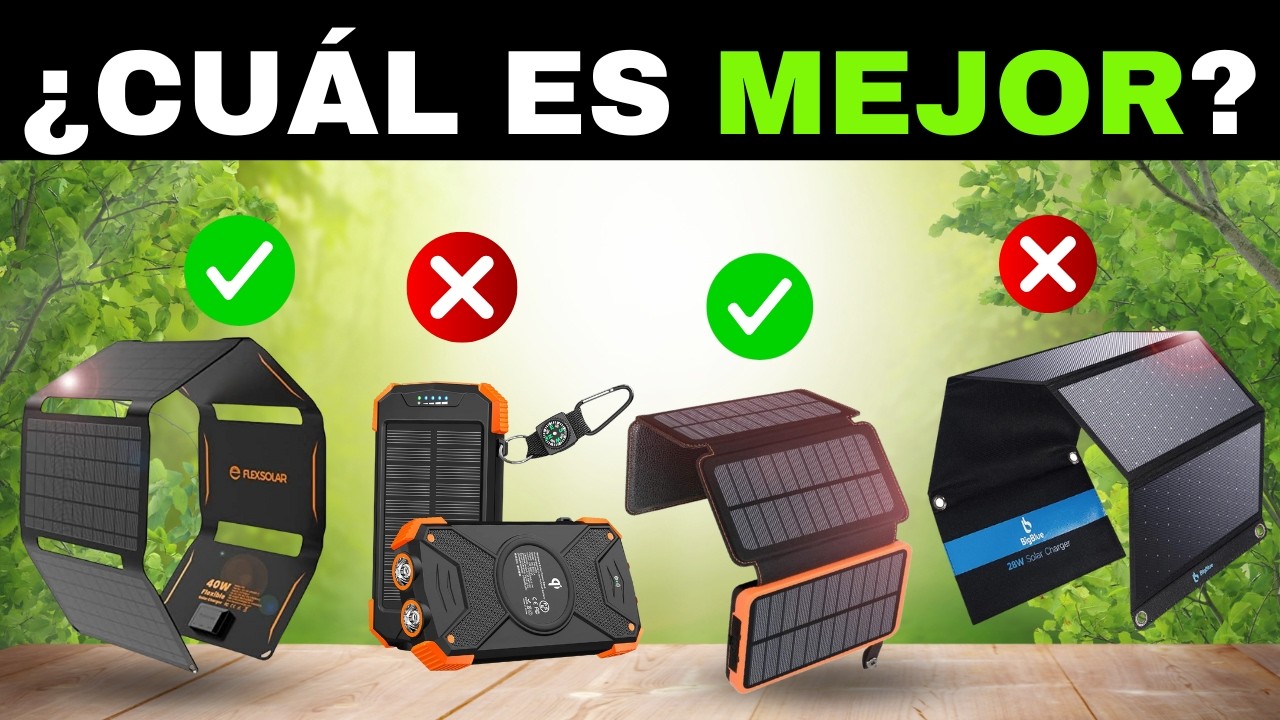
Para la mayoría de los viajeros, el BigBlue 28W USB Solar Charger es la compra más equilibrada: pesa 1,4 libras, se pliega hasta 11 × 6 × 1 pulgadas y ofrece 28 W en cuatro láminas. Si necesitas cargar varios dispositivos lejos de una toma, el Allpowers SP012 Solar Panel 100W aporta 100 W, tres USB y salida DC, aunque pesa 4,9 libras y ocupa 3 × 3 pies desplegado. No incorpora batería almacenada: sirve para alimentar dispositivos o recargar batteries compatibles.
Si vas muy justo de espacio, el BigBlue funciona mejor que un panel de 100 W, pero su conjunto de puertos resulta limitado. Para una laptop, revisa si el dispositivo acepta carga por USB-C y cuál es su consumo; un panel powerful no garantiza carga directa si el protocolo no coincide. El Allpowers SP012 Solar Panel 100W es la opción de la lista para uso off-grid exigente, no para una mochila mínima.
Los datos están comprobados en octubre de 2026. Los precios son referencias de Estados Unidos y cambian según el país y la oferta.
Los cinco criterios que separan un cargador útil de otro
- Potencia solar. Mide el valor nominal del panel, no la potencia máxima que puede alcanzar en condiciones de laboratorio. El BigBlue declara 28 W; el Allpowers SP012, 100 W. Para elegir, calcula primero cuántos dispositivos usarás y si lanzador lanzador they'll accept energy simultaneously.
- Batería almacenada. Un panel no equivale a un banco de energía: el BigBlue está descrito como cargador solar y no consta una batería interna. El Allpowers también funciona como fuente directa. Si necesitas energía cuando no hay sol, comprueba expresamente la capacidad en mAh y la salida del banco; no presupongas que el panel la tiene.
- Puertos y protocolos. El BigBlue ofrece 3 USB-A y no tiene USB-C ni DC. El Allpowers combina 1 USB-C, 2 USB-A y DC. Para una laptop, importan el protocolo USB-C Power Delivery, la potencia admitida y el formato físico del conector.
- Peso y tamaño. El BigBlue weighs 1,4 libras y plegado mide 11 × 6 × 1 pulgadas. El Allpowers pesa 4,9 libras y desplegado ocupa 3 × 3 pies, además de medir 4 pulgadas de grosor plegado. These differences determine what fits in a backpack.
- Resistencia. El BigBlue has IPX4, while the Allpowers has IP65. These classifications refer to different protection levels: before taking either one near rain, check what the manufacturer says about exposed connectors and whether the panel must remain dry during use.
Comparativa de modelos: potencia, batería, puertos, peso y precio
| Modelo | Potencia | Conexiones |
|---|---|---|
| BigBlue 28W USB Solar Charger | 28 W | 3 USB-A |
| Allpowers SP012 Solar Panel 100W | 100 W | 1 USB-C, 2 USB-A y DC |
El material no ofrece una capacidad de batería comparable para ambos productos; por eso no se incluye esa columna ni se presupone autonomy. BigBlue has an IPX4 classification and weighs 1,4 libras; Allpowers has an IP65 classification and weighs 4,9 libras. Their reference prices are 75 USD (~67 € · ~1.390 MXN · ~236.640 COP · ~115.540 ARS) y 143 USD (~128 € · ~2.660 MXN · ~451.190 COP · ~220.290 ARS), respectivamente (octubre de 2026), in the United States market; availability and final price vary by country and promotion.
BigBlue 28W: el equilibrio más sólido para mochila y campamento
El BigBlue 28W USB Solar Charger tiene una potencia nominal de 28 W y cuatro láminas solares. Pesa 1,4 libras y, plegado, mide 11 × 6 × 1 pulgadas. Sus 3 USB-A permiten conectar dispositivos por USB-A, pero no incluye USB-C ni una salida DC. Su clasificación IPX4 ofrece una protección básica frente al agua y el polvo; no debe interpretarse como waterproof.
Su precio de referencia es 75 USD (~67 € · ~1.390 MXN · ~236.640 COP · ~115.540 ARS) (octubre de 2026) en Estados Unidos. Conviene si buscas un conjunto relatively light and inexpensive for a backpack or emergency kit, and you expect to charge devices that use USB-A. The official product page of the BigBlue 28W USB Solar Charger is the reference to verify its current specifications before purchase.
La_LIMITACIÓN principal está en los puertos: una laptop que solo admite carga USB-C no puede conectarse directamente. Tampoco consta una batería almacenada, así que no lo compres si necesitas energía almacenada para después de después que se retire el sol. Los 28 W furthermore represent nominal panel power, not a guaranteed charging rate under partial shade.
Hiluckey 25000mAh: el más útil cuando no dependes del sol
El Hiluckey 25000mAh combina una batería de 25.000 mAh con un panel solar de 5 W y una clasificación IP67. Esa cifra de capacidad resulta mucho más relevante que el tamaño del panel si el viaje incluye días nublados, informativo flights or periods without light. The USB-A and USB-C ports allow you to check and connect the devices to be used, but the material does not specify their maximum output current.
Este modelo has a clear use case: carry enough stored energy for several phone charges without relying on a sunny window. Its IP67 classification also provides more reassurance than the BigBlue's IPX4, although it does not authorize immersion and does not remove the need to protect connectors during heavy rain.
The limitation is power: 5 W is suitable for maintaining or slowly replenishing a battery, but it should not be confused with the 28 W of the BigBlue or the 100 W of the Allpowers. The material does not provide dimensions, complete port output specifications or a price with a verifiable reference. Check the manufacturer's Hiluckey 25000mAh page for those details.
Anker 24W y Goal Zero Nomad 20 Plus: carga directa para teléfonos
El Anker 24W utiliza tecnología PowerIQ y ofrece 3 puertos USB para conectar dispositivos. El Goal Zero Nomad 20 Plus combina USB-A y USB-C y declara una salida de 18 W para carga rápida. Ambos están orientados a teléfonos y otros equipos pequeños, no a una workstation.
La diferencia práctica is the protocol and port layout. El Anker 24W prioriza several USB connections under one brand ecosystem; el Goal Zero Nomad 20 Plus offers a more direct combination for equipment with USB-C. Antes de comprar, comprueba que el cable y el dispositivo accept the load, because a faster charging label only applies within each port’s stated limits.
Las disadvantages are concrete: sus paneles están optimized for smartphones rather than laptops, and the material does not provide comparable battery capacity, weight or protection data for both models. Therefore, no claims are made about which stores more energy or resists water better. If your trip is based on charging only the phone and you value low weight over off-grid output, these are the models to review. Verify current specifications and prices in the official Anker 24W page and the Goal Zero Nomad 20 Plus page.
FlexSolar 40W y Jackery SolarSaga 100W: cuando la laptop entra en el viaje
El FlexSolar 40W ofrece 40 W y USB-C Power Delivery de 30 W. El Jackery SolarSaga 100W alcanza 100 W. El FlexSolar therefore fits the case where a laptop accepts up to 30 W over USB-C; it should not be presented as sufficient for every notebook, since many require more power than that.
The Jackery SolarSaga 100W has the higher nominal panel output, but that number alone does not determine whether it will charge a laptop efficiently. You need to verify the USB-C port’s output power, supported Power Delivery profiles, voltage, current and whether the computer will accept charging directly from the panel. Also check the cable: some laptops require a specific USB-C cable that includes the electronic circuit needed for high-power charging.
These models target work travel with devices that consume more energy than a phone. Neither can be recommended as a stored-energy solution unless the manufacturer’s specifications confirm a battery and its usable capacity. The material does not provide comparable weight, dimensions, IP rating or a verifiable reference price for this pair, so those data must be checked in the official FlexSolar 40W page and the Jackery SolarSaga 100W page.
Errores de compra y accesorios que suelen faltar
Antes de salir, make a checklist with these items:
- USB-C cable compatible. USB-C describes the connector shape, not necessarily the charging protocols. For a laptop, confirm that the cable supports Power Delivery and the wattage required by the computer.
- Adaptador de enchufe. It lets you recharge the panel or battery from a conventional wall outlet, avoiding dependence on sunlight during the trip.
- Batería externa. It stores energy for night, tunnels, flights and prolonged cloudy periods. Check its capacity in mAh, its real output specifications and whether it is compatible with your devices.
- Bolsa impermeable. It protects the panel and accessories during rain and transport. IP ratings refer to specific conditions; do not assume that every connector can remain exposed.
Two limitations are worth planning for. First, charging through a window works only partially: glass blocks part of the light, and the panel usually must remain in the same position rather than following the sun. Second, partial shade can reduce output substantially; a single shaded area can limit the power produced by the entire panel. For reliable phone charging, place the panel in direct sun and connect the battery or device according to the manufacturer’s instructions.
Finally, do not judge by wattage alone. Check the battery capacity, ports and supported protocols, then verify weight and dimensions against the space available in your backpack.
Fuentes
- Made-in-chinaCargador Solar Portátil Ligero y Fácil de Llevar 28Wconsultado el 27/10/2026
- OutdoortechlabPortable Solar Chargers Become Camping Must-Haves for 2026consultado el 27/10/2026